Fitness & Movement
Recovering from injury without losing everything
Complete rest is rarely the answer, and the fitness lost during a badly managed injury takes far longer to rebuild.
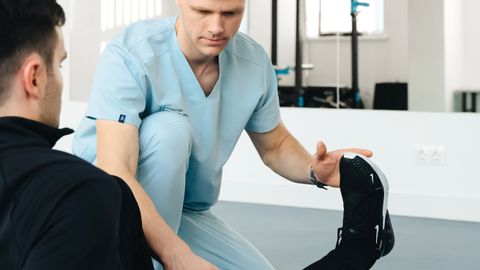
The traditional response to injury was rest, and the evidence has moved decisively towards controlled loading, which changes both the recovery and what is lost along the way.
Why complete rest is usually wrong
Tissues adapt to load and deconditions without it.
Prolonged immobilisation produces muscle atrophy, joint stiffness, reduced bone density and loss of cardiovascular fitness, all of which then have to be rebuilt.
Tendons in particular respond to progressive loading and do poorly with rest, which is why tendinopathy treatment is now loading-based.
Which does not mean loading a fresh fracture — it means that the period of protection should be as short as clinically necessary and that something can usually be trained meanwhile.
The updated acronyms
Which reflect the change.
The traditional advice was rest, ice, compression and elevation.
Newer frameworks emphasise protection for a short period, optimal loading thereafter, and the avoidance of prolonged rest — with reduced emphasis on ice and anti-inflammatories, since inflammation is part of healing and there is concern that suppressing it may impair tissue repair.
The practical version: protect briefly, move early within tolerance, load progressively, and avoid the extremes of doing nothing and doing everything.
Training around an injury
The principle that preserves the most.
An injured ankle does not prevent upper body training.
A shoulder problem does not prevent lower body work or cycling.
Cardiovascular fitness can usually be maintained through some modality — swimming, cycling, rowing, walking — even when the primary activity is not possible.
Training the uninjured limb produces a documented cross-education effect, with strength gains transferring partially to the immobilised side.
Which means the person who trains everything else during a six-week injury returns in far better condition than the person who stopped entirely.
Pain as a guide
Where the rules are more permissive than people assume.
For most musculoskeletal conditions, monitored pain during rehabilitation is acceptable, with common frameworks permitting pain up to a moderate level during exercise provided it settles within a day and does not increase over time.
Which contradicts the instinct to avoid all discomfort and is the basis of most tendon rehabilitation.
What is not acceptable: pain that increases session to session, swelling that worsens, or any loss of function.
And this framework does not apply to fractures, acute injuries under investigation, or anything with red flag features.
The timeline
Realistic expectations.
Muscle strains heal over weeks depending on grade.
Tendinopathies take months, frequently three to six, with loading programmes.
Bone stress injuries require a period without impact loading followed by graded return, typically over months.
Ligament injuries vary enormously by grade and structure.
Post-surgical timelines are dictated by tissue healing rather than by how you feel, which is why they are protocol-driven.
Underestimating these timelines and returning early is the most common cause of recurrence.
Returning to activity
The graded approach.
Meet defined criteria rather than dates: full range of movement, symmetrical strength, ability to perform the relevant movements without pain, and confidence.
Return at reduced volume and intensity, and progress one variable at a time.
Expect the first sessions back to feel worse than expected, since fitness declines faster than people anticipate.
Continue the rehabilitation exercises after returning, since stopping them is a common cause of recurrence.
And accept that previous injury is the strongest predictor of future injury, which makes the maintenance work worth continuing indefinitely.
What to spend money on
An honest ranking.
An accurate diagnosis, which determines everything else.
A structured rehabilitation programme with progression, which is the treatment.
A small number of supervised sessions to learn technique and get the programme right.
And essentially nothing else.
Passive treatments, braces, supports, taping, supplements and recovery devices range from mildly useful adjuncts to expensive placebos, and none of them substitute for progressive loading.
When to seek assessment
Rather than self-managing.
Inability to bear weight or use the limb.
Obvious deformity, or a joint that feels unstable.
Significant swelling immediately after injury.
Numbness, weakness or pins and needles.
Night pain, unexplained weight loss, fever, or a history of cancer.
Localised bone pain that worsens with activity, which may be a bone stress injury.
Pain that is not improving after a few weeks of sensible management.
And any injury to a child near a growth plate, which requires assessment rather than assumption.
General information only, not medical advice. Consult a qualified clinician or physiotherapist about injury, particularly with deformity, instability, numbness or inability to bear weight.
Also by Oliver Nkemdi
- Cooking skills that save the most moneyFood & Budget
- What fitness trackers can and cannot tell youFitness & Movement
- Fibre, and why it is the nutrient that matters mostFood & Budget
- Exercise with a long-term conditionFitness & Movement